The cheapest GPU capacity, on one platform
We continuously search the open GPU marketplace for the lowest-priced hosts that meet your hardware requirements, then run your Docker workloads on them. You get one account, one prepaid balance and one invoice - instead of a contract, a console and a bill for every provider.
From payload to paid usage without manual GPU operations.
The portal confirms the user, API key scope, task payload, and idempotency key.
Estimated spend is locked before the runtime leases a worker or starts a GPU.
Your Docker image claims the task, pulls scoped media, and streams logs.
Runtime seconds, artifacts, and final spend are posted back to the dashboard.
Raw GPU marketplaces are operational debt
- You juggle SSH keys, instance lifecycles, and manual teardown to avoid idle spend.
- Private media has to be handed to untrusted workers as raw URLs or bucket credentials.
- There is no per-account credit control, task history, or billing surface out of the box.
Webtunel adds the account and runtime layer
- A queue reserves credit, leases tasks, and records every event and artifact.
- Stream keys scope private media access to one job and expire quickly.
- Auth, credit, invoices, and logs live in one Supabase-backed portal.
One product, two surfaces, real GPUs.
The dashboard on webtunel.com drives the runtime on super-proxy.webtunel.com, which boots and controls GPU workers across multiple capacity sources.
Register, add credit, submit tasks, and read timelines, logs, and invoices.
Queue, worker leases, stream keys, and GPU provider control plane.
Your Docker worker image claims tasks and writes artifacts back.
User owns tasks, stream keys, events, invoices, and credit balance.
The runtime validates credit, creates reservations, and assigns work.
Docker workers process payloads and stream task events back.
Everything a GPU processing account needs.
Queue, credit, keys, logs, instances, and billing - all owner-scoped.
Task queue
Submit jobs over REST with idempotency keys. The runtime leases work to workers and tracks every state change.
Credit enforcement
Credit is reserved before a task runs and settled against real instance usage. No silent overspend.
Stream keys
Workers get short-lived, job-scoped keys to private media instead of raw storage URLs or bucket credentials.
Live logs
Stream worker stdout and runtime events into the dashboard while a task is still in flight.
Instance usage
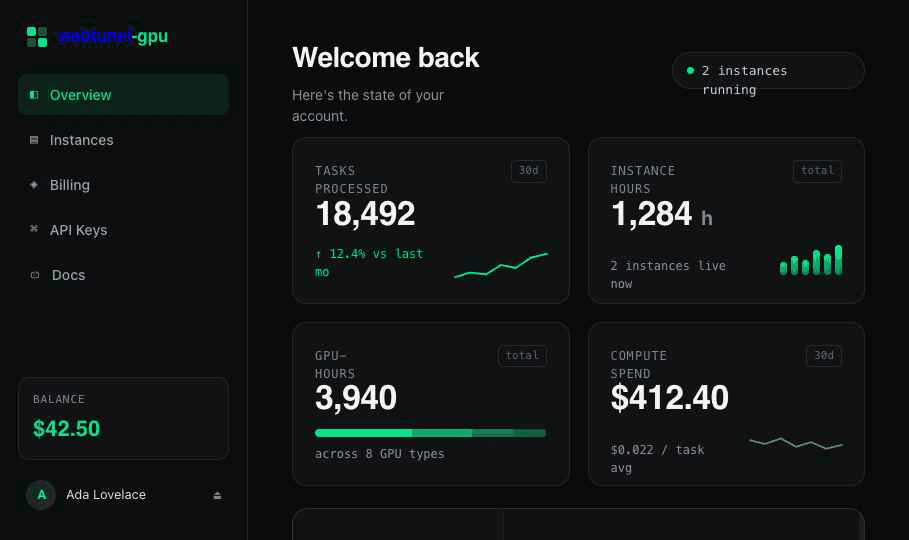
See which GPU instances are running, GPU class, hourly rate, and utilization in one table.
Admin credits
Operators grant, adjust, and audit credit balances with a full transaction ledger.
Billing & invoices
Stripe-backed credit packages, downloadable invoices, and a running spend breakdown.
Profile & data
Owner-scoped rows keep every task, key, and invoice tied to the account that created it.
Built for production GPU pipelines.
Video processing
Transcode, segment, and analyze private video without exposing source URLs to GPU workers.
Computer vision
Run detection and segmentation models across batches of frames with per-second billing.
Batch inference
Fan large prompt or embedding jobs out to warm workers and collect artifacts per task.
Media pipelines
Chain extract, enrich, and render stages where each stage is its own queued task.
Internal GPU jobs
Give internal teams a credit-metered, account-scoped surface instead of raw provider access.
Prepaid credit, marketplace GPU rates.
Top up credit, reserve it before a task runs, and pay by real instance usage. Examples track live multi-source GPU market rates.
Credit is reserved when a task is enqueued and settled against actual instance usage. Cancellation releases the unused reservation.
Submit, reserve, process, inspect.
01. Submit a task
POST /v1/tasks with a payload and an Idempotency-Key from dashboard or API.
02. Runtime reserves credit
The runtime checks the balance, reserves estimated cost, and enqueues the task.
03. Worker processes
A worker claims the lease, runs your image, and reports progress and artifacts.
04. Artifacts & logs appear
Timeline events, logs, and artifacts surface on the dashboard task view in real time.
Least-privilege by default.
Auth, API keys, stream keys, and row ownership keep every account isolated and every worker scoped to one job.
Supabase Auth
Sessions, password reset, and JWT verification run through Supabase Auth.
Scoped API keys
Keys carry least-privilege scopes for task submission and runtime calls.
Short-lived stream keys
Media keys are minted per job with a TTL and revoked on cancel.
Owner-scoped rows
Row-level ownership keeps tasks, keys, and invoices isolated per account.
Go deeper before you build.
Guides & references
Implementation guides, architecture references, and operational checklists.
Browse resourcesPlatform engineering
How credit-safe queues, the runtime split, and stream keys are built.
Read the blog